Review About No More Reading for Junk

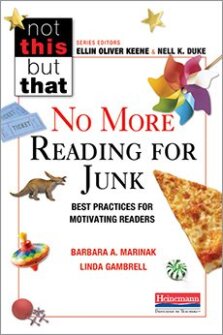
Barbara Marinak and Linda Gambrell agreed to answer a few questions about their volume, No More Reading For Junk: Best Practices For Motivating Readers .
Barbara A. Marinak, Ph.D. is Professor and Department Chair of the Education Section at Mountain St. Mary's University where she teaches literacy and inquiry courses. Dr. Marinak is the co-author of No More Reading Junk and Maximizing Motivation for Literacy Learning: Grades K-half dozen.
Linda B. Gambrell is Distinguished Professor of Education at Clemson University. She is a old classroom instructor and reading specialist. She has written books on reading instruction and published articles in major literacy journals, including Reading Research Quarterly, The Reading Teacher, and Journal of Educational Enquiry.
LF: As you point out in the book, plenty of enquiry demonstrates problems with using extrinsic motivation as a teaching tool. Could you requite a curt summary of information technology, particularly equally it relates to reading?
Barbara Marinak and Linda Gambrell:
Teachers want students to be motivated readers--to choose to read for personal pleasance and information. And nosotros desire our students to exist intrinsically motivated to read, rather dependent upon extrinsic incentives and rewards. The research is clear that "reading for junk" like prizes, money, and processed can be counterproductive. Over twenty years ago, a large-scale assay of the research conducted on the classroom use of rewards and incentives concluded that extrinsic rewards do not necessarily accept a positive or negative impact on intrinsic reading motivation, mental attitude, time on task, and operation. Using extrinsic rewards made little deviation in increasing children's motivation and achievement.
Research suggests that, in general, rewards and incentives actually subtract motivation. In fact, the enquiry indicates that if you reward a student who already enjoys reading with an extrinsic reward, the student may choose to read less often one time the incentive or reward is discontinued. It appears that extrinsic rewards may have a detrimental effect on intrinsic motivation to read, particularly for those students who are already motivated and engaged readers.
At that place is as well evidence that individuals are motivated by the reward itself. For example, if we are paid to do a task such as reading, it may result in a decrease in our want to read; however, beingness paid may be very effective in motivating an private to make money. We tend to view the "advantage" as desirable and valuable. If we desire to develop the intrinsic desire to read, books and extra time to read are dandy examples of the kinds of rewards we want to offering to our students.

LF: Since the research shows extrinsic motivation doesn't work, why practise y'all think it is so prevalent, whether it's classroom stickers or a principal maxim he/she volition sit on the roof if students read a certain number of books?
Barbara Marinak and Linda Gambrell:
Extrinsic rewards and incentives are all effectually us in our lives. We are rewarded with a paycheck for the work we practise, we promise ourselves a "commemoration" dinner when we've lost ten pounds, or we shop at the aforementioned supermarket each calendar week to get points for a Thanksgiving turkey. None of these "rewards' are necessarily bad or negative. What the enquiry strongly suggests, withal, is that we must be very thoughtful about how and when we use rewards in the classroom. In a study that Barbara and I conducted with unproblematic students, we constitute that giving children extrinsic rewards that were related to reading--such as books, fourth dimension to read, and choices about where and when to read--supported the development of intrinsic motivation, while "junk rewards" such every bit prizes and tokens decreased students' motivation to read.
Nosotros think information technology is of import to recognize that not all extrinsic rewards have negative consequences. Enquiry indicates that the "principal on the roof" volition nigh likely not be constructive in nurturing students' motivation to read for a number of reasons. The reward of seeing the chief sitting on the roof is likewise far removed (past weeks and mayhap months) from the actual human action of reading that the students do. When rewarding a behavior in an endeavor to foster motivation, the presentation of the advantage must be immediate. Students value the reward less the longer they have to wait for it. On the other paw, the "primary on the roof" does draw attention to reading and maybe the important notion that the principal values reading. The of import thing to recall is that activities like "principal on the roof" and giving students "junk rewards" for reading are not probable to increment students' intrinsic motivation to read. Intrinsic motivation is critical because intrinsically motivated students enjoy reading and are more likely to choose to read more often than students who do not enjoy reading. And, the more students read, the better readers they become. We don't really need to be convinced that reading is a good matter for our students. The larger question is, "How exercise nosotros create classroom environments that back up our students in developing the reading habit"
Nosotros think that because nosotros know how important information technology is for every child to acquire to read, that many of these types of extrinsic activities are done to become children excited nigh books and reading. It is of import to distinguish betwixt the types of activities that are designed to get children excited about reading (such as the chief on the roof) and activities that are designed to help children develop the intrinsic desire to read such as the ones nosotros describe in our book (Encounter Book Blessing and Personal Invitation to Read). Teachers promote students' intrinsic motivation to read every day as they create classroom climates that inspire children to exist engaged and motivated literacy learners and provide a rich array of reading materials, tasks, and activities that are relevant to students' interests.
LF: In the book, you criticize book leveling - just having students read books on their "level." Can you lot elaborate on why yous remember that is non a helpful didactics and learning practice?
Barbara Marinak and Linda Gambrell:
Book leveling and matching text to a reader is absolutely critical when choosing text for instruction. Our leveling concern is related to independent reading and educatee choice. One of the most disturbing trends nosotros have seen in contempo years is the restriction of access to books and periodicals in the schoolhouse and classroom libraries. Nosotros have seen classrooms where children are non permitted to explore and choose books from sections of library that are accounted to exist "non on their level." We have besides seen libraries where books are marked or labeled to coincide with a schoolhouse-wide leveling or incentive system. In this case, children are permitted to select contained reading materials marked at their level. If a child's reading level has been identified as "double orange," that child tin only select books from the double orange shelves or lower.
There announced to exist two reasons for this practice: (1) the desire on the function of teachers and/or librarians to guide children to books "on their level", and (2) the leveling of materials is suggested by a schoolhouse-wide or classroom incentive programme. Both reasons give u.s.a. interruption. Outset, inherent in the notion that teachers and librarians want to guide students to book "on their level" is that students have a "level." In reality, young readers have many levels. They can read a broad range of text, depending on their prior noesis, experience with genre, and motivation. Nosotros have all seen the child who can read a dinosaur volume years above a perceived grade level because he is a walking talking dinosaur encyclopedia. The more than noesis he has about dinosaurs, the more background he brings to harder books. And the more challenging books children read, the more than knowledge they gain. 2nd, leveling is ofttimes associated with reading incentive programs. Any reading incentive program that limits gratuitous choice will not result in nurturing intrinsic motivation and can actually result in eroding reading motivation.
We believe in the library values Benjamin Franklin envisioned in 1727: access, diversity, and the public proficient. Imagine how you lot would feel if someone tapped yous on the shoulder in the library and said, "Sad, I don't recollect you will understand that volume" or, "No, y'all are not allowed to borrow from the department." A way to achieve this is to afford your children the same liberty and privileges you await in a library. Permit independent reading time to be truly independent.

LF: You propose in your book that ARC (admission, relevance and choice) is the alternative to extrinsic motivation for reading. Can yous share a few of your favorite specific and applied strategies from the volume that fall under that umbrella?
Barbara Marinak and Linda Gambrell:
1 of our favorite under Access is "Recognize your Superpower!" Teachers matter! You are disquisitional to nurturing and supporting the reading motivation of your students, regardless of their age or form level. Even though they might not look like they care most your feedback and encouragement (every bit is ofttimes the instance during adolescence), your words and actions practice not go unnoticed. You are a hero, and your super power is the ability to motivate! No need to dress in a duck adjust or climb on the roof of the school. Trade these fun but not helpful practices in for a steady diet of thoughtful questions and deportment. Your passion and involvement tin get a long style toward helping your students recognize the relevance of reading. Rather than request, "What are you lot reading correct now?" put passion into that inquiry and ask, "What practise you love reading right now?" (Condon 2014). And never give up on less engaged or struggling readers. These are the students who demand you the most. Set aside time every twenty-four hour period to check in with them. Focus on what they read or can read versus what they shy away from or struggle to become through.
A great idea to promote Relevance is "Your Reading Life." At that place is naught more relevant, and motivating, than to honor the significant books in a child's life. Your Reading Life invites children and their families to revisit the print they have shared. Invite them to bring in the books that accept been important in their lives. Examples: the commencement book mom read aloud; the book grandma gave me when I started kindergarten; the book I reread every summer, to name just a few. Your Reading Life celebrates that reading is and always has been a huge office of their lives. Thinking and talking about past readings, connecting them to important people and events, and being invited to share their experiences reminds children they have and always will read for purpose and pleasance!
No doubt, our favorite suggestion for Choice is "Offer Pick of the Teacher Read-Aloud". Why practise we e'er select the read-aloud? There are, of grade, skillful reasons. Teachers select books they dearest--and passion is contagious! Read-alouds are often selected to introduce students to new genres or topics. All expert! However, several of our studies revealed children's want to be involved in selecting books. They expressed a desire for choice in the teacher read-aloud. We heard comments that students exercise not enjoy the teacher read-aloud because "he/she never asks me what I want to hear," "he/she e'er reads girl books," or "he/she never reads things I am interested in." Inviting students to help select the teacher read-aloud is a powerful and easy way to offer choice. In fact, when this is an option in classrooms, nosotros're amazed by the newfound enthusiasm for the teacher read-aloud.
LF: What do you lot think are the biggest challenges facing teachers who want to move from the extrinsic model to the strategies your recommend, and how tin can they overcome them?
Barbara Marinak and Linda Gambrell:
Perhaps the biggest challenge facing teachers who want to move from the extrinsic motivational practices is a belief that such a shift is difficult, time consuming, or that information technology might compromise their current curriculum. We wrote "No More than Reading for Junk" to dispel these very notions. Our inquiry indicates that less can be more! Small changes tin brand a significant difference in reading motivation. Just providing pick of the instructor read aloud or inviting students to share their reading lives tin become a long mode toward nurturing intrinsic reading motivation in those who are less than enthusiastic readers. Our book contains a diversity of constructive ways teachers can hands incorporate access, relevance, and selection beyond into their instruction.
LF: What practice you think are the biggest challenges facing teachers who desire to movement from the extrinsic model to the strategies your recommend, and how tin they overcome them?
Barbara Marinak and Linda Gambrell:
Perhaps the biggest challenge facing teachers who desire to move from the extrinsic motivational practices is a belief that such a shift is hard, fourth dimension consuming, or that it might compromise their current curriculum. We wrote "No More Reading for Junk" to dispel these very notions. Our inquiry indicates that less tin be more than! Small changes can make a pregnant divergence in reading motivation. Just providing pick of the teacher read aloud or inviting students to share their reading lives can become a long way toward nurturing intrinsic reading motivation in those who are less than enthusiastic readers. Our book contains a diverseness of effective ways teachers can easily incorporate access, relevance, and pick across into their instruction.
LF: Is at that place anything I haven't asked yous about that you'd similar to share?
Barbara Marinak and Linda Gambrell:
We promise the ARC of motivation proves helpful to all the teachers out there working hard to nurture intrinsic reading motivation!
LF: Cheers, Barbara and Linda!
Salvage
Save
Salvage
The opinions expressed in Classroom Q&A With Larry Ferlazzo are strictly those of the writer(s) and do not reverberate the opinions or endorsement of Editorial Projects in Education, or any of its publications.
Source: https://www.edweek.org/teaching-learning/opinion-no-more-reading-for-junk-an-interview-with-barbara-marinak-linda-gambrell/2016/09
0 Response to "Review About No More Reading for Junk"
Postar um comentário