How to Read a 4 Lead Ecg
This guide demonstrates how to read an ECG using a systematic approach. If you want to put your ECG interpretation knowledge to the examination, check out our ECG quiz on the Geeky Medics quiz platform.
Yous may too be interested in our ECG flashcard deck which can be purchased every bit part of our collection of one thousand+ OSCE flashcards.
Ostend details
Before beginning ECG interpretation, you should check the post-obit details:
- Ostend the name and date of nascence of the patient matches the details on the ECG.
- Check the date and time that the ECG was performed.
- Check the scale of the ECG (normally 25mm/due south and 10mm/1mV).
You might also be interested in our OSCE Flashcard Drove which contains over 2000 flashcards that cover clinical examination, procedures, advice skills and data interpretation.
Heart rate
What'south a normal adult middle charge per unit?
- Normal: 60-100 bpm
- Tachycardia: > 100 bpm
- Bradycardia: < 60 bpm
Regular eye rhythm
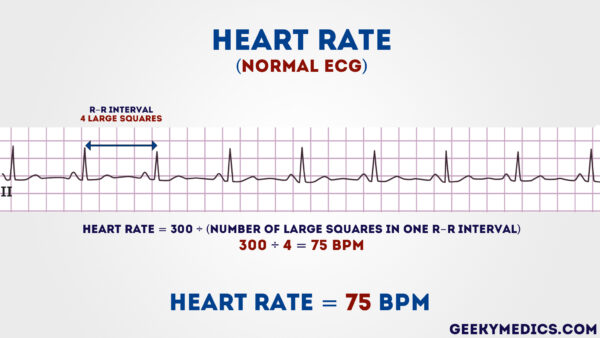
If a patient has a regular heart rhythm their heart charge per unit can be calculated using the following method:
- Count the number of large squares present within i R-R interval.
- Separate 300 past this number to calculate heart charge per unit.
Heart rate calculation instance
- 4 large squares in an R-R interval
- 300/4 = 75 beats per minute
Irregular heart rhythm
If a patient'due south heart rhythm is irregular the first method of heart rate adding doesn't work (equally the R-R interval differs significantly throughout the ECG). As a result, yous need to employ a different method:
- Count the number of complexes on the rhythm strip (each rhythm strip is typically ten seconds long).
- Multiply the number of complexes by half-dozen (giving you the average number of complexes in 1 minute).
Middle charge per unit calculation case
- x complexes on a rhythm strip
- 10 x six = 60 beats per minute
Heart rhythm
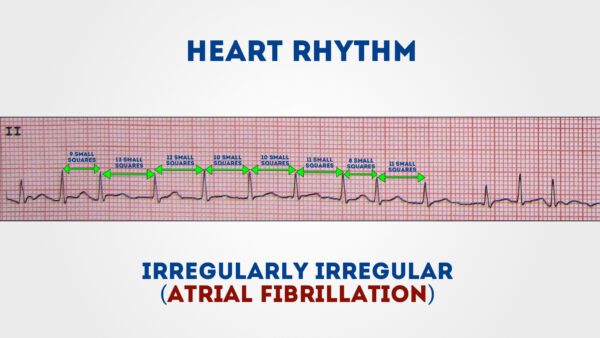
A patient'south heart rhythm can be regular or irregular.
Irregular rhythms can be either:
- Regularly irregular (i.due east. a recurrent pattern of irregularity)
- Irregularly irregular (i.eastward. completely disorganised)
Marking out several consecutive R-R intervals on a piece of newspaper, then move them along the rhythm strip to check if the subsequent intervals are like.
Hint
If you are suspicious that there is some atrioventricular cake (AV block), map out the atrial rate and the ventricular rhythm separately (i.e. marker the P waves and R waves). As you movement forth the rhythm strip, you can then come across if the PR interval changes, if QRS complexes are missing or if there is complete dissociation between the 2.
Cardiac axis
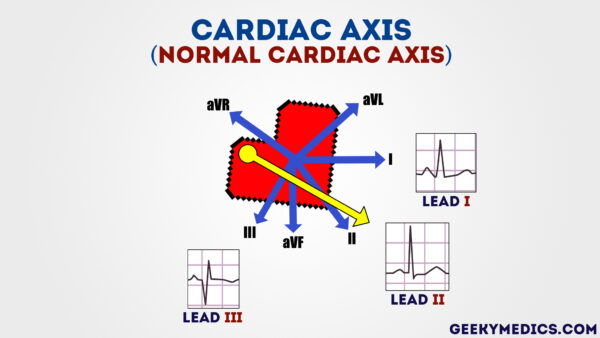
Cardiac axis describes the overall management of electric spread within the heart.
In a healthy private, the axis should spread from eleven o'clock to 5 o'clock.
To determine the cardiac axis y'all need to look at leads I, 2 and Three.
Read our cardiac axis guide to learn more.
Normal cardiac axis
Typical ECG findings for normal cardiac centrality:
- Lead II has the most positive deflection compared to leads I and 3.
Correct centrality deviation
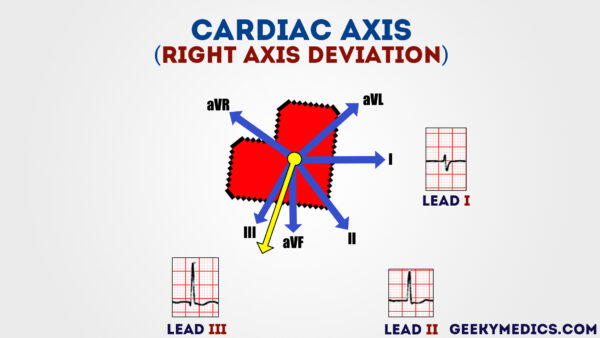
Typical ECG findings for right axis departure:
- Pb Iii has the most positive deflection and pb I should be negative.
- Right axis difference is associated with right ventricular hypertrophy.
Left axis divergence
Typical ECG findings for left centrality difference:
- Lead I has the nigh positive deflection.
- Leads II and 3 are negative.
- Left centrality deviation is associated with middle conduction abnormalities.

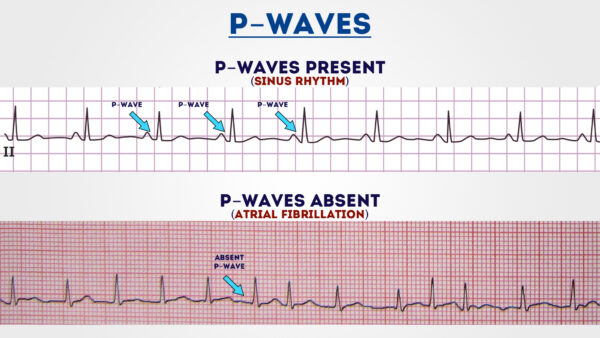
P waves
The next step is to await at the P waves and answer the following questions:
ane. Are P waves present?
ii. If then, is each P wave followed by a QRS circuitous?
3. Practice the P waves look normal? – check duration, direction and shape
4. If P waves are absent-minded, is there whatever atrial activity?
- Sawtooth baseline → flutter waves
- Cluttered baseline → fibrillation waves
- Flat line → no atrial activity at all
Hint
If P waves are absent and there is an irregular rhythm information technology may suggest a diagnosis of atrial fibrillation.
PR interval
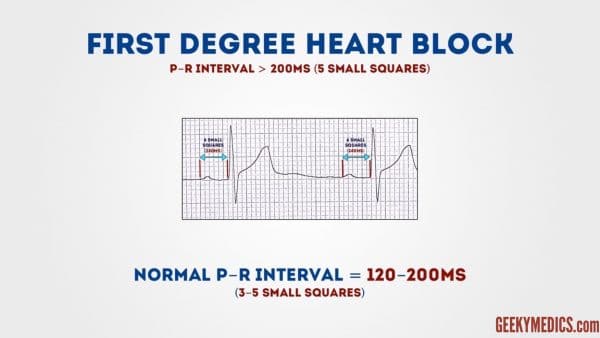
The PR interval should be between 120-200 ms(iii-five small squares).
Prolonged PR interval (>0.2 seconds)
A prolonged PR interval suggests the presence of atrioventricular delay (AV block).
Beginning-degree centre cake (AV cake)
Offset-caste center block involves a fixed prolonged PR interval (>200 ms).
Second-degree heart block (type ane)
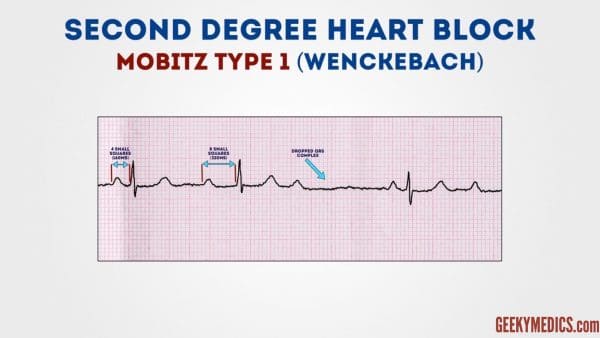
Second-caste AV cake (type 1) is also known asMobitz type one AV block orWenckebach phenomenon.
Typical ECG findings in Mobitz blazon ane AV block includeprogressive prolongation of the PR interval until eventually the atrial impulse is non conducted and theQRS complex is dropped.
AV nodal conductionresumes with the next beat and the sequence of progressive PR interval prolongation and the eventual dropping of a QRS complexrepeats itself.
Second-degree eye block (blazon 2)
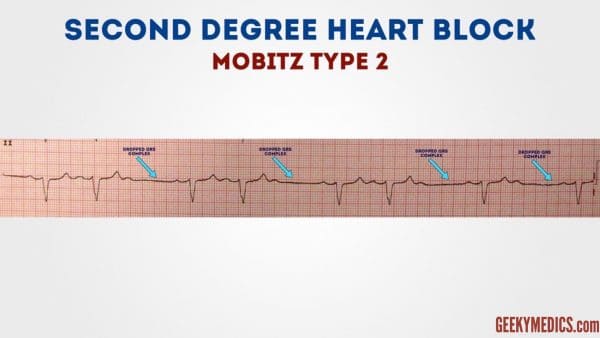
Second-degree AV cake (type two) is likewise known every bitMobitz blazon 2 AV block.
Typical ECG findings in Mobitz type 2 AV block include a consistent PR interval duration withintermittently dropped QRS complexes due to a failure of conduction.
The intermittent dropping of the QRS complexes typically follows arepeating bike of everytertiary (3:1 block) or4th (4:1 cake)P wave.
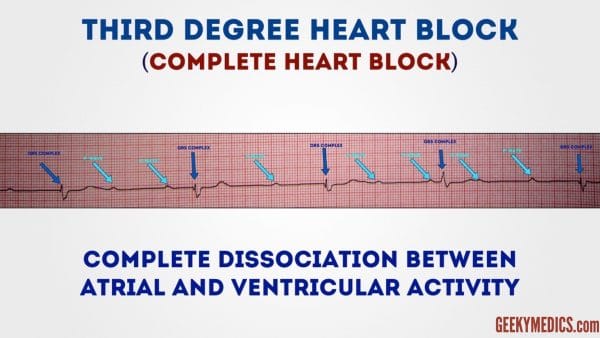
3rd-caste middle block (complete heart cake)
Tertiary-caste (complete) AV block occurs when there is no electric communicationbetwixt theatria andventricles due to a complete failure of conduction.
Typical ECG findings include thepresence of P waves andQRS complexes that haveno association with each other, due to the atria and ventricles functioning independently.
Cardiac function is maintained by ajunctional orventricularpacemaker.
Narrow-complex escape rhythms (QRS complexes of <0.12 seconds elapsing) originateabove the bifurcation of theparcel of His.
Wide-complex escape rhythms (QRS complexes >0.12 seconds duration) originate frombelow the bifurcation of the bundle of His.
Tips for remembering types of heart block
To help recall the various types of AV cake, it is useful to know the anatomical location of the block within the conducting system.
First-caste AV block:
- Occurs between the SA node and the AV node (i.e. within the atrium).
Second-degree AV block:
- Mobitz I AV block (Wenckebach) occurs IN the AV node (this is the only slice of conductive tissue in the heart which exhibits the ability to comport at different speeds).
- Mobitz II AV block occurs AFTER the AV node in the bundle of His or Purkinje fibres.
3rd-degree AV block:
- Occurs at or afterward the AV node resulting in a consummate blockade of distal conduction.
Shortened PR interval
If the PR interval is shortened, this tin can hateful i of 2 things:
- Simply, the P wave is originating from somewhere closer to the AV node then the conduction takes less time (the SA node is not in a fixed place and some people's atria are smaller than others).
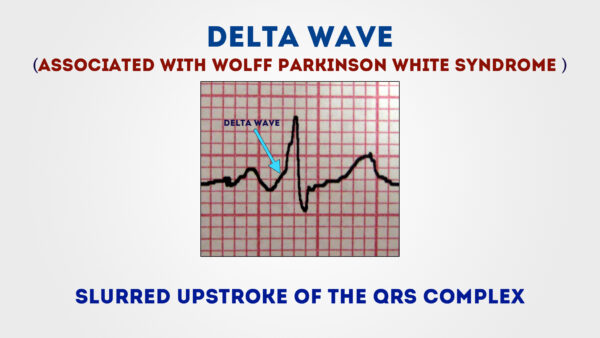
- The atrial impulse is getting to the ventricle by a faster shortcut instead of conducting slowly across the atrial wall. This is an accessory pathway and tin exist associated with a delta wave (see below which demonstrates an ECG of a patient with Wolff Parkinson White syndrome).
QRS complex
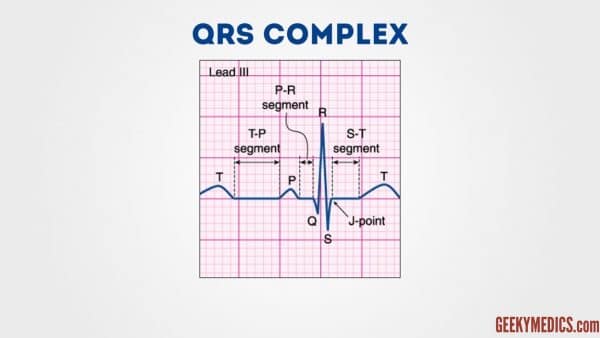
When assessing a QRS complex, you need to pay attention to the post-obit characteristics:
- Width
- Peak
- Morphology
Width
Width tin be described equally NARROW (< 0.12 seconds) or Wide (> 0.12 seconds):
- A narrow QRS complex occurs when the impulse is conducted down the bundle of His and the Purkinje fibre to the ventricles. This results in well organised synchronised ventricular depolarisation.
- A broad QRS complex occurs if there is an abnormal depolarisation sequence – for instance, a ventricular ectopic where the impulse spreads slowly across the myocardium from the focus in the ventricle. In contrast, an atrial ectopic would result in a narrow QRS complex because it would conduct down the normal conduction organisation of the heart. Similarly, a bundle branch block results in a broad QRS complex considering the impulse gets to one ventricle rapidly down the intrinsic conduction organization then has to spread slowly beyond the myocardium to the other ventricle.
Height
Height can be described as either SMALL or TALL:
- Small-scale complexes are defined equally < 5mm in the limb leads or < ten mm in the chest leads.
- Alpine complexes imply ventricular hypertrophy (although can exist due to body habitus due east.chiliad. tall slim people). There are numerous algorithms for measuring LVH, such as the Sokolow-Lyon index or the Cornell index.
Morphology
To assess morphology, you lot demand to assess the individual waves of the QRS circuitous.
Delta moving ridge
The mythical 'delta wave' is a sign that the ventricles are being activated earlier than normal from a betoken distant to the AV node. The early activation then spreads slowly across the myocardium causing the slurred upstroke of the QRS complex.
Note – the presence of a delta moving ridge does NOT diagnose Wolff-Parkinson-White syndrome. This requires show of tachyarrhythmias AND a delta wave.
Q-waves
Isolated Q waves can exist normal.
A pathological Q wave is > 25% the size of the R moving ridge that follows it or > 2mm in height and > 40ms in width.
A unmarried Q moving ridge is not a cause for concern – look for Q waves in an unabridged territory (east.g. anterior/inferior) for evidence of previous myocardial infarction.

R and South waves
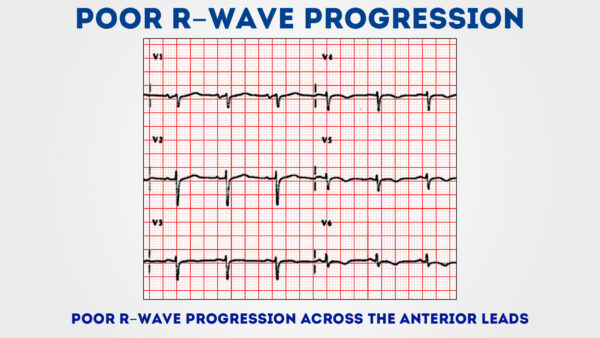
Appraise the R wave progression beyond the chest leads (from modest in V1 to large in V6).
The transition from S > R wave to R > S moving ridge should occur in V3 or V4.
Poor progression (i.e. South > R through to leads V5 and V6) tin can be a sign of previous MI but can also occur in very large people due to poor lead position.
J point segment
The J point is where the S wave joins the ST segment.
This point can be elevated resulting in the ST segment that follows it also being raised (this is known equally "high take-off").
Loftier have-off (or benign early repolarisation to requite its full title) is a normal variant that causes a lot of angst and confusion every bit information technology LOOKS similar ST elevation.
Fundamental points for assessing the J point segment:
- Benign early repolarisation occurs generally under the age of 50 (over the historic period of 50, ischaemia is more common and should be suspected first).
- Typically, the J bespeak is raised with widespread ST elevation in multiple territories making ischaemia less probable.
- The T waves are as well raised (in contrast to a STEMI where the T wave remains the same size and the ST segment is raised).
- The ECG abnormalities do non change! During a STEMI, the changes will evolve – in benign early repolarisation, they will remain the same.
ST segment
The ST segment is the part of the ECG betwixt the end of the S wave and the start of the T moving ridge.
In a salubrious individual, it should be an isoelectric line (neither elevated nor depressed).
Abnormalities of the ST segment should be investigated to rule out pathology.
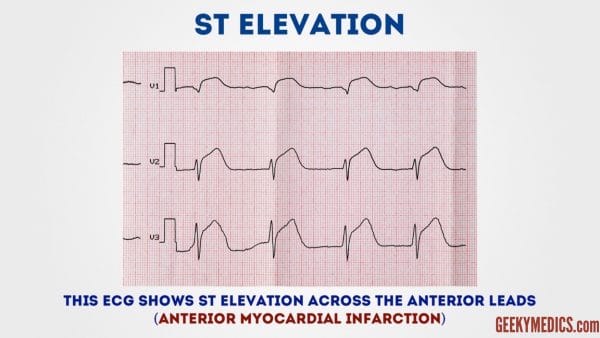
ST-elevation
ST-elevation is significant when information technology is greater than i mm (one pocket-size square)in 2 or more than contiguous limb leads or >2mm in 2 or more chest leads.
It is about commonly caused by astute total-thickness myocardial infarction.
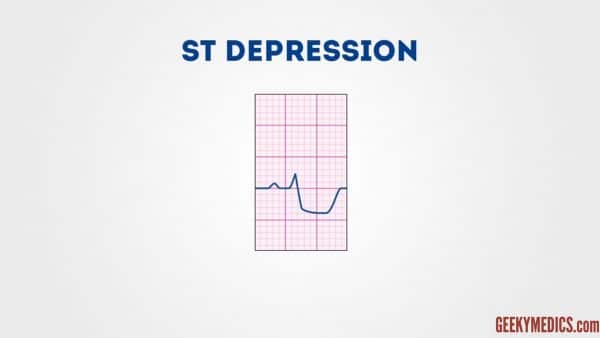
ST depression
ST depression ≥ 0.5 mm in ≥ 2 face-to-face leads indicates myocardial ischaemia.
T waves
T waves represent repolarisation of the ventricles.
Tall T waves
T waves are considered tall if they are:
- > 5mm in the limb leads AND
- > 10mm in the chest leads (the same criteria as 'modest' QRS complexes)
Tall T waves can be associated with:
- Hyperkalaemia ("tall tented T waves")
- Hyperacute STEMI

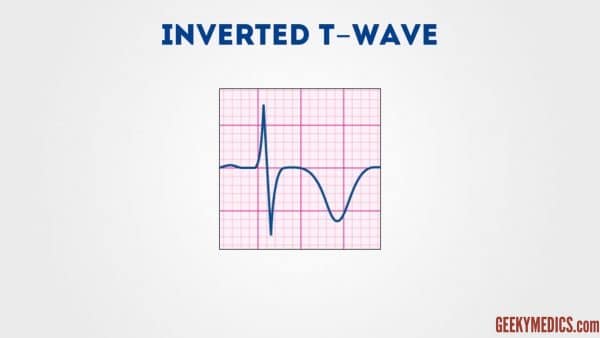
Inverted T waves
T waves are ordinarily inverted in V1 and inversion in lead 3 is a normal variant.
Inverted T waves in other leads are a nonspecific sign of a wide diversity of atmospheric condition:
- Ischaemia
- Parcel branch blocks (V4-6 in LBBB and V1-V3 in RBBB)
- Pulmonary embolism
- Left ventricular hypertrophy (in the lateral leads)
- Hypertrophic cardiomyopathy (widespread)
- General affliction
Around 50% of patients admitted to ITU take some evidence of T moving ridge inversion during their stay.
Observe the distribution of the T moving ridge inversion (e.thou. anterior/lateral/posterior leads).
You must have this ECG finding and apply information technology in the context of your patient.
Biphasic T waves
Biphasic T waves accept ii peaks and can be indicative of ischaemia and hypokalaemia.

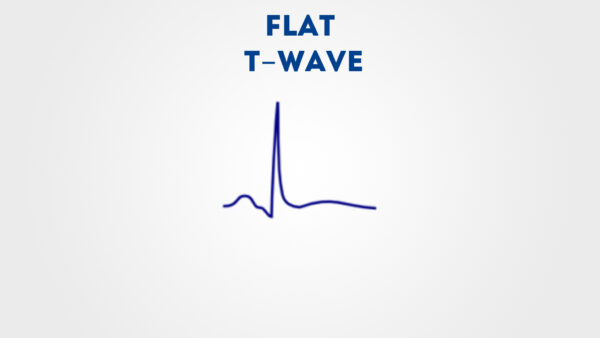
Flattened T waves
Flattened T waves are a not-specific sign, that may represent ischaemia or electrolyte imbalance.
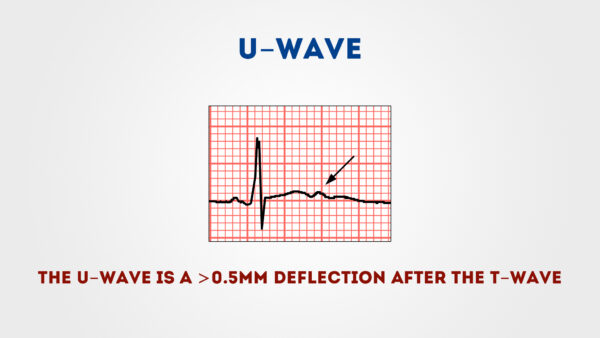
U waves
U waves are not a common finding.
The U moving ridge is a > 0.5mm deflection after the T wave best seen in V2 or V3.
These become larger the slower the bradycardia – classically U waves are seen in various electrolyte imbalances, hypothermia and secondary to antiarrhythmic therapy (such as digoxin, procainamide or amiodarone).
Certificate your interpretation
You lot should document your interpretation of the ECG in the patient's notes (cheque out our guide to documenting an ECG).
References
- James Heilman, MD. Fast atrial fibrillation. Licence: CC BY-SA iii.0.
- Michael Rosengarten BEng, MD.McGill. Right axis deviation. Licence: CC BY-SA 3.0.
- James Heilman, MD. Mobitz type 2 AV cake. Licence: CC By-SA three.0.
- James Heilman, MD. Consummate heart block. Licence: CC Past-SA 3.0.
- James Heilman, Md. Delta moving ridge. Licence: CC By-SA three.0.
- Michael Rosengarten BEng, Physician.McGill. Q-waves. Licence: CC By-SA 3.0.
- Michael Rosengarten BEng, Physician.McGill. Poor R-wave progression. Licence: CC BY-SA 3.0.
- Michael Rosengarten BEng, MD.McGill. Alpine tented T-waves. Licence: CC BY-SA 3.0.
- CardioNetworks. T-wave morphology. Licence: CC Past-SA 3.0.
- James Heilman, Md. U-moving ridge. Licence: CC By-SA 3.0.
- Michael Rosengarten BEng, Md.McGill. Left axis divergence. Licence: CC By-SA three.0.

Source: https://geekymedics.com/how-to-read-an-ecg/
0 Response to "How to Read a 4 Lead Ecg"
Postar um comentário