what causes your water to smell ransit in your house
- Locating the Source of the Odor
- Drinking Water: Mutual olfactory property problems, probable causes and suggested corrective measures
- References
Homeowners sometimes experience unpleasant odors in their household water. In many cases, the exact cause of the odor is hard to make up one's mind by h2o testing; however, this publication provides a few general recommendations for treating some common causes of household h2o odors.
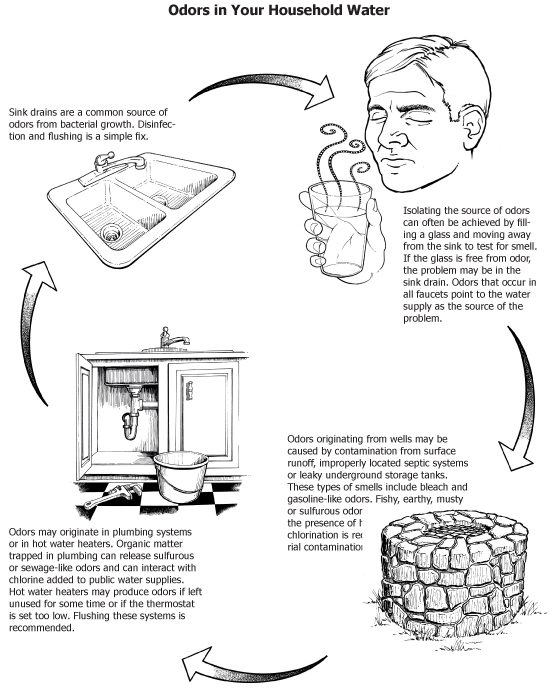
Locating the Source of the Aroma
If odor occurs in all h2o faucets, the problem is probably in the main h2o supply. If information technology occurs only in sure faucets, the trouble is likely in the fixtures or pipes supplying those specific faucets. If the problem goes away afterwards running the water for a few minutes, the problem is somewhere in the household plumbing system. If the odour is persistent, the problem could exist the h2o source or a combination of both the h2o source and the plumbing system. Figure 1 outlines the possible sources of odors in water.
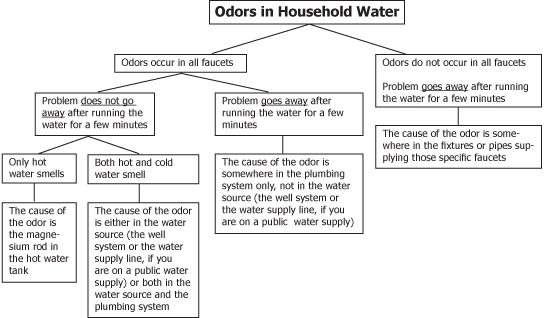 Figure one. A decision tree to help locate household water odor sources.
For odors coming from the plumbing system or the well system, corrective measures are suggested. If you obtain water from a public water supply (PWS) and the odor is suspected to originate from the water source line, contact your water provider. This is particularly true if your neighbors also experience the same blazon of odor problem.
Drinking Water: Mutual odor problems, probable causes and suggested corrective measures
If a particular odor trouble in your household h2o and its crusade are not included in this listing, discuss the trouble with a drinking water professional from your water provider (if you are on a public water supply), county health department or UGA Cooperative Extension agent (i-800-Ask-UGA-1).
a. Bleach, Chemical or Medicinal Odor
Public h2o suppliers generally chlorinate h2o to prevent bacterial growth. Typical levels of free chlorine in drinking water from PWS are 0.ii - 2.0 parts per million (ppm), though levels can be every bit high equally 5.0 ppm. Odors resulting from a chlorine addition usually get abroad if the water is exposed to air for several minutes.
Adding chlorine to the water through stupor chlorination of a well or plumbing arrangement produces a strong bleach (chlorine) aroma. The bleach smell stops when chlorine completely dissipates. This requires turning on outside faucets and letting the water run until the smell is gone.
In some cases, the added chlorine may collaborate with organic materials congenital up in the plumbing system and add olfactory property to the water. The odor should disappear subsequently running the water for a few minutes. Use Figure 1 to locate the source of the odour. If h2o is supplied by your own well and the problem appears to be in your plumbing and/or well systems, then your entire water arrangement should exist flushed, preferably by a licensed well driller or pump installer. If you are on a PWS and the problem appears to exist the water supply line, contact your water supply authority.
b. Rotten Eggs (Sulfurous), Rust-covered or Sewage-like Scent
By and large, a rotten egg (or sulfurous), rust-covered or sewage-like scent in household water is a effect of bacterial activity, which can be due to:
- Bacteria growing in the drain: This is the about common cause of these types of odors. Over time, organic matter such equally hair, soap and food waste can accrue on the walls of the drain. These deposits serve as a food for leaner to grow. The leaner tin can produce a gas that smells like rotten eggs or sewage. Address this trouble by following these two steps:
- Starting time, ensure that both the common cold and hot h2o have the smell and that the smell is coming out of one or several faucets, simply not all. Make full a glass with water from the sink that has the aroma, then step abroad from the sink and swirl the water around inside the glass few times. If the problem is in the bleed, the tap water in the drinking glass should not have an odor.
- If the water in the glass does not smell, y'all should disinfect and flush the drain.
- Leaner growing in the water heater: Bacteria growing in the h2o heater can also produce a rotten egg or sewage smell. Often, this occurs if the hot water is unused, if the water heater is turned off for a significant period of time or if the thermostat on the heater is set up besides low. Mostly, the bacteria that produce this trouble are not a health threat; all the same, the sense of taste and odor can be very unpleasant. To address this trouble, the following actions are suggested:
- Brand sure that hot water smells, but cold water does not. Frequently, the odour originates from a magnesium heating rod in the hot water tank.
- If the heater has a magnesium rod, a licensed plumber can supersede it with an adequate alternative such every bit an aluminum rod.
- Bacteria growing in the well: If problems with the bleed or water heater are ruled out, the odor may be coming from the h2o source. Do not apply the water because it may contain harmful bacteria. To address this problem, the following actions are suggested:
- If you are on your own well, the natural groundwater chemical science may exist supporting bacterial growth in the well. Shock chlorinate the well and pump out water until the chlorine odor disappears. For a pace-by-stride daze chlorination procedure, refer to the Academy of Georgia publication "Disinfecting Your Well Water: Shock Chlorination."
- A defective or improperly located septic system may be present near your well. Contact your county wellness department.
- If you lot are on a PWS, contact your water supply dominance or county health department immediately.
For more information about rotten egg odor, refer to the University of Georgia publication "Your Household Water Quality: Hydrogen Sulfide and Sulfate."
c. Musty, Moldy, Bawdy, Grassy or Fishy Odor
Although these odors are harmless, the human senses of taste and smell are extremely sensitive fifty-fifty at a very depression level. These kinds of odors may exist due to:
- Decaying organic matter in the drain
- Pollution of well water from surface drainage
The presence of bacteria is very common in both cases. By far, the most common crusade of this type of problem is the decaying organic matter deposited over time in the drain. To make sure the trouble is not in the well, fill a glass with tap water, and then step away from the sink and swirl the water effectually within the glass few times. If the trouble is in the drain, the tap h2o in the glass should non have an smell. Disinfecting, cleaning and flushing the drain should eliminate the smell.
The reservoir/pressure tank may also be the source of such an odor. Cleaning and maintaining the reservoir/ pressure tank periodically tin can preclude bacteria from growing to levels that cause odor in the water. Less commonly, certain types of algae, fungi and bacteria growing in the h2o supply, specially during warm weather, tin can affect the h2o odor.
If the problem is in the well, stupor chlorinate the well and pump out plenty of water until the scent of chlorine disappears. If the problem persists, consider installing:
- An activated carbon filter OR
- An automatic chlorinator followed by an activated carbon filter.
If yous are on a PWS and insufficient chlorine is being used to disinfect the water, certain types of bacteria may grow in the supply line and cause these kinds of odors. Contact your water supply authority or county health department.
d. Petroleum, Gasoline, Turpentine, Fuel-like or Solvent-like Smell
Even though these odor problems are rare, they are potentially serious. These odors may exist due to:
- A leaking fuel tank or undercover fuel storage tank nigh your well
- Discharge from factories or landfills contaminating the water supply
- Run-off from agriculture contaminating the h2o supply
End drinking the water because it may cause several adverse health consequences, including but not limited to:
- Anemia
- Increased run a risk of cancer
- Liver and kidney problems
Remedial actions include:
- Report the problem to your county health department
- Eliminate the source of the problem
- Install an activated carbon filtration arrangement after determining the blazon and source of the chemical contaminant
If you are on a PWS, contact your water supply authority and county health section immediately.
east. Other Odors
| Odor | Probable Crusade | Possible Health Effects | Suggested Remedies |
| Detergent aroma or foaming h2o |
|
|
|
| Methane gas odor |
|
|
|
| Sharp chemic odor |
|
|
|
References
Colour, Taste, and Aroma Issues in Drinking Water. Fact Sheet. Washington Section of Wellness, Jan, 2011. http://world wide web.doh.wa.gov/portals/1/Documents/pubs/331-286.pdf
Color, Taste, and Odor: What you should know. Massachusetts Section of Environmental Protection. http://world wide web.mass.gov/dep/water/drinking/colour.htm
Liukkonen, B. 2011. Why Well H2o Smells Bad. University of Minnesota Extension. http://www.extension.umn.edu/environment/housing-technology/moisture-management/why-water-smells-bad/.
Saha, U., L. Sonon, M. Risse and D. Kissel. 2011. Water Quality and Common Treatments for Private Drinking Water Systems. Message 939 (Revised July 2011). University of Georgia Cooperative Extension. https://extension.uga.edu/publications/detail.html?number=B939
Globe Health System. 2008. Guidelines for Drinking-water Quality. Chapter 10. Acceptability Aspects: Taste, Odor and Appearance. WHO Printing, Globe Health Organization, Geneva, Switzerland.
Reviewers: Mark Risse and William Carlan, Academy of Georgia; Kristine Uhlman, Texas A&M University; Beth Thomas, AdEdge Water Technologies, Inc.
Status and Revision History
Published on May xv, 2012
Published with Full Review on Mar 28, 2017
Published with Full Review on Sep 13, 2021
Source: https://extension.uga.edu/publications/detail.html?number=C1016&title=Your%20Household%20Water%20Quality:%20Odors%20in%20Your%20Water
0 Response to "what causes your water to smell ransit in your house"
Postar um comentário