Ventura Kc When Will I See U Again
| |
|---|---|
 | |
| A Lockheed PV-ane Ventura | |
| Role | Patrol bomber |
| National origin | United states |
| Manufacturer | Lockheed |
| First flight | 31 July 1941 |
| Primary users | United States Navy
|
| Developed from | Lockheed Model xviii Lodestar |
The Lockheed Ventura is a twin-engine medium bomber and patrol bomber of Earth State of war 2.
The Ventura first entered combat in Europe as a bomber with the RAF in belatedly 1942. Designated PV-ane past the United States Navy (US Navy), information technology entered gainsay in 1943 in the Pacific. The bomber was also used by the United states of america Army Air Forces (USAAF), which designated it the Lockheed B-34 (Lexington) and B-37 as a trainer. British Commonwealth forces likewise used it in several guises, including antishipping and antisubmarine search and assault.
The Ventura was developed from the Lockheed Model 18 Lodestar transport, as a replacement for the Lockheed Hudson bombers then in service with the Royal Air Forcefulness. Used in daylight attacks confronting occupied Europe, they proved to accept weaknesses and were removed from bomber duty and some used for patrols by Coastal Control.
After USAAF monopolization of land-based bombers was removed, the US Navy ordered a revised design which entered service as the PV-2 Harpoon for anti-submarine work.
Evolution [edit]
Lockheed Ventura/B-34 Lexington [edit]

At the beginning of the war, Lockheed proposed armed forces conversions of the Lodestar for the RAF every bit replacement for the Hudson reconnaissance aircraft and the Bristol Blenheim bomber. The showtime British club was placed in Feb 1940 for 25 Model 32 equally bombers. This was followed by an order for 300 Model 37 with Double Wasp engines, then for a farther 375 later on in 1940. Lockheed needed more than production capacity and nearby Vega Shipping Corporation was contracted for building the Ventura.
The Ventura was very similar to its predecessor, the Lockheed Hudson. The primary difference was non in layout; rather, the Ventura was larger, heavier, and used more powerful engines than the Hudson. The RAF ordered 188 Venturas in February 1940, which were delivered from mid-1942. Venturas were initially used for daylight raids on occupied Europe but, like some other RAF bombers, they proved besides vulnerable without fighter escort, which was difficult to provide for long-range missions. Venturas were replaced by the faster de Havilland Musquito. The Venturas were transferred to patrol duties with Coastal Command every bit the Musquito replaced them in bomber squadrons; 30 went to the Purple Canadian Air Force (RCAF) and some to the South African Air Force (SAAF). The RAF placed an club for 487 Ventura Marker IIs merely many of these were diverted to the USAAF, which placed its own order for 200 Ventura Mark IIA as the B-34 Lexington, later renamed RB-34.
Lockheed B-37 [edit]
In Baronial 1941, large orders for Venturas were placed with Lend-Lease Human activity money. Among the orders were for 550 armed reconnaissance versions of the Ventura. This aircraft was originally planned to be congenital under the designation O-56. The principal differences between the Ventura and the O-56 were in the engines: rather than the 2,000 hp (ane,491 kW) Pratt & Whitney R-2800 radials of the Ventura, the O-56 used ane,700 hp (1,270 kW) Wright R-2600-xiii radials.
Before completion of the offset O-56, the U.S. Army Air Forces dropped the "O-" category used to designate "observation" (reconnaissance) shipping. The O-56 was redesignated the RB-34B (the R denoted 'restricted' meaning it was not to be used for combat). Before the first of these flew, the pattern was redesignated again as the B-37 with a college powered version of the R-2600, afterwards it also was designated the RB-37.
While 550 were ordered past the Army Air Forces, acquisition by the USAAF stopped afterwards only eighteen Venturas were accepted, when the Army Air Forces agreed to turn over exclusive apply of the Ventura to the Us Navy.
PV-i Ventura [edit]

The PV-1 Ventura, congenital past the Vega Aircraft Company division of Lockheed (hence the "V" Navy manufacturer's letter that afterward replaced the "O" for Lockheed), was a version of the Ventura built for the U.S. Navy (see Venturas in U.Due south. Navy service beneath). The main differences between the PV-1 and the B-34 were the inclusion of special equipment in the PV-1, adapting information technology to its patrol bombing role. The maximum fuel chapters of the PV-1 was increased from 1,345 gal (5,081 l) to 1,607 gal (6,082 50), to increase its range; the forward defensive armament was also reduced for this reason. The most important addition was of an ASD-1 search radar.
Early on product PV-1s still carried a bombardier'southward station behind the olfactory organ radome, with four side windows and a flat bomb-aiming panel underneath the olfactory organ. Late production PV-1s dispensed with this bombardier position and replaced it with a pack with 3 0.50 inch (12.7 mm) automobile guns underneath the nose. These aircraft could also carry eight 5-inch (127 mm) HVAR rockets on launchers underneath the wings.
The PV-one began to be delivered in December 1942, and entered service in February 1943. The first squadron in combat was VP-135, deployed in the Aleutian Islands in April 1943. They were operated past iii other squadrons in this theatre. From the Aleutians, they flew strikes confronting bases in Paramushiro and Shimushu, Japanese islands in the Kurile chain. Often, PV-1s would lead B-24 bomber formations, since they were equipped with radar. In late 1943, some PV-1s were deployed to the Solomon Islands every bit night fighters with VMF(N)-531, a Marine Corps fighter squadron.
PV-2 Harpoon [edit]

A PV-2 Harpoon in flight in 1945

PV-two Harpoon at the National Naval Aviation Museum at Naval Air Station Pensacola in 2008

PV-2 Harpoon at the National Naval Aviation Museum at Naval Air Station Pensacola in 2009

PV-2 Harpoon repainted and marked "Air Tropic Island Charters" on display at a miniature golf game course in North Myrtle Beach, Southward Carolina in 2012
The PV-2 Harpoon was a major redesign of the Ventura with the fly expanse increased from 551 ftii (51.2 mii) to 686 ft2 (63.7 mii) giving an increased load-carrying capability, and which first flew on three December 1943. The motivation for redesign was weaknesses in the PV-ane, which had shown itself to have bug in taking off when carrying a total load of fuel. On the PV-2, the armament became standardized at five forward-firing machine guns. Many early on PV-1s had a bombardier'due south position, which was deleted in the PV-ii. Some other significant developments included the increase of the bombload by 30% to four,000 lb (one,800 kg), and the power to carry eight 5-inch (127 mm) HVAR rockets under the wings.
While the PV-2 was expected to take increased range and better takeoff, the anticipated speed statistics were projected lower than those of the PV-1, due to the use of the same engines but an increase in weight. The Navy ordered 500 examples, designating them with the pop name Harpoon.
Early tests indicated a tendency for the wings to wrinkle dangerously. As this problem could not be solved past a 6 ft (i.8 k) reduction in wingspan (making the wing uniformly flexible), a complete redesign of the wing was necessitated. This hurdle delayed entry of the PV-ii into service. The PV-2s already delivered were used for training purposes under the designation PV-2C. Past the end of 1944, but 69 PV-2s had been delivered. They finally resumed when the redesign was consummate. The first aircraft shipped were the PV-2D, which had eight frontwards-firing machine guns and was used in ground attacks. When World State of war Two ended, all of the society was cancelled.
With the fly problems stock-still, the PV-two proved reliable, and eventually popular. Information technology was offset used in the Aleutians by VP-139, 1 of the squadrons that originally used the PV-1. Information technology was used past a number of countries after the state of war'south end, but the Usa ceased ordering new PV-2s, and they were all soon retired from service.

Civil conversions [edit]

Howard 350 executive conversion of the PV-1
Ex-military PV-1 Venturas from Canada and Southward Africa were converted by Howard Aero in San Antonio, Texas, in the 1950s and 1960s equally loftier-speed executive transports. The earliest conversions, called Super Venturas, incorporated a 48 in (122 cm) fuselage stretch, extra fuel tankage, large motion-picture show windows, luxury interiors, and weapons bays transformed into baggage compartments. The landing gear was swapped for the heavier-duty units from the PV-2. Later conversions, of which eighteen were completed in the 1960s,[ane] were called Howard 350s.[2]
At to the lowest degree xix PV-1s were further modified, including cabin pressurization under the designation Howard 500.[3] A concluding PV-one modification by Howard was the Eldorado 700, with longer wings, a pointed olfactory organ, and streamlined engine cowlings.
A notable crash of a civilian version occurred on December 17, 1954, killing four, including Fred Miller, president of the Miller Brewing Company and grandson of founder Frederick Miller. The company aeroplane was spring for Winnipeg, Manitoba, but had problem with both engines and crashed shortly later takeoff from Mitchell Field in Milwaukee, Wisconsin.[4] [5] Too killed were his oldest son, xx-year-old Fred, Jr., and the ii company pilots, Joseph and Paul Laird.[6] [7]
Oakland Airmotive (later Bay Aviation Services, based in Oakland, California) also offered a PV-two executive aircraft conversion dubbed Centaurus starting in 1958.[8] The toll of the conversion was $155,000 in addition to the airframe.[9]
Operational history [edit]
Portuguese Air Forcefulness [edit]
The Portuguese Air Force received 42 Lockheed PV-2C Harpoons from 1953, which replaced the Curtiss SB2C-five Helldiver every bit an anti-submarine aircraft. The Harpoons equipped squadrons 61 and 62 at the Montijo Air Base. In 1960, the Harpoons were replaced as maritime patrol and anti-submarine aircraft past Lockheed P2V-five Neptunes. The remaining Harpoons were sent to Republic of angola and Mozambique, where they formed Squadron 91 operating from Luanda Air Base and Squadron 101 from Beira Air Base. The Harpoons were used on operations in the Angolan and Mozambican theatres of the Portuguese Overseas War (1961–1974). They served mainly as light bombers and footing attack shipping, with occasional reconnaissance, transport and maritime patrol sorties. The concluding Portuguese Harpoons were retired in 1975.[ten] The Museu do Ar (Portuguese Air Museum) has what is believed to be the only remaining Lockheed PV-2C Harpoon in Europe.
Royal Air Force [edit]

The first Ventura Mark Is were accepted by the Purple Air Force (RAF) in September 1941, with shipping existence delivered to Great britain from April 1942.[eleven] [12] By the end of Baronial, enough Venturas had arrived to equip No. 21 Squadron RAF, No. 487 Squadron RNZAF and No. 464 Squadron RAAF.[xiii] The Ventura flew its first operational mission for the RAF on iii Nov 1942, when iii Venturas of 21 Squadron attacked railway targets near Hengelo in holland.[xiv] [15] On 6 December 1942, 47 Venturas from 21, 464 (RAAF) and 487 (RNZAF) squadrons participated in Operation Oyster, the large daylight 2 Group raid confronting the Philips radio and vacuum tube factories at Eindhoven. Too committed to the raid were 36 Bostons and 10 de Havilland Mosquitos.[16]
Carrying incendiaries, they were placed in the third wave of aircraft, and suffered the highest rate of loss. 9 of the 47 Venturas were shot downward and many others were damaged by flak or bird strikes. The force also lost four Bostons and one Mosquito.[17] Half dozen months afterwards, on iii May 1943, Venturas of 487 Squadron RNZAF were sent on Operation Ramrod sixteen, an attack on a power station in Amsterdam. The squadron was told that the target was of such importance to Dutch morale, that the assault was to exist continued regardless of opposition. Meaning bug developed with rendezvousing with the escorting fighters, with the result that all 10 Venturas that crossed the declension were lost to German fighters. Squadron Leader Leonard Trent (after the last of the Great Escapers) won the Victoria Cross for his leadership in this raid.
The Ventura was never very popular among RAF crews. Although it was l mph (eighty km/h) faster and carried more than than twice the bomb load of its predecessor, the Hudson, it proved unsatisfactory as a bomber. By the summertime of 1943, the Ventura had been replaced by the de Havilland Mosquito. The last Ventura raid was flown by 21 Squadron on ix September 1943. Some Venturas were modified to be used by Coastal Command every bit the Ventura G.R.I. and 387 PV-1s were used past the RAF as the Ventura G.R.V in the Mediterranean and by Coastal Control. Some RAF shipping were modified into Ventura C.Five transport shipping. A small number of Venturas were too used in other air forces, including the RCAF, RNZAF and SAAF.
Regal Australian Air Force [edit]
In the Britain, No. 464 Squadron RAAF formed (mixure of Commonwealth personnel) at RAF Feltwell in September 1942 to operate the Ventura as role of 2 Group, Bomber Control; information technology converted to the de Havilland Mosquito in September 1943. In the Mediterranean, No. 459 Squadron RAAF was equipped with the Ventura V betwixt December 1943 to July 1944, flight mainly anti-submarine and anti-shipping patrols.
In Australia, 55 PV-1s were supplied to the RAAF for use in the South West Pacific Surface area. No. 13 Squadron RAAF was the only operational squadron in Commonwealth of australia equipped with the Ventura. It operated primarily in north-eastern Queensland and then the Northern Territory, and later serving in the Borneo campaign of 1945. After the war, the squadron used its shipping to help send liberated prisoners of war.
Royal Canadian Air Forcefulness [edit]
A total of 157 Ventura Yard.R. Mk. Vs were used operationally past the RCAF from 16 June 1942 to xviii Apr 1947 in the abode defense coastal patrol part in both Eastern and Western Air Command. They were flown by 8, 113, 115, 145, and 149 Squadrons. A further 21 Ventura Mk. Is and 108 Ventura Mk. IIs were used in a preparation role at 1 Central Flight School, Trenton, Ontario, and at RCAF Station Pennfield Ridge, New Brunswick (RAF No. 34 Operational Training Unit) as role of the BCATP. A total of 21 Mk. Is, 108 Mk. IIs, and 157 1000.R. Mk. Vs were in service during this period for a full of 286 aircraft.
S African Air Force [edit]
The SAAF as well received some 135 PV-1s, which were used to protect shipping around the Cape of Good Promise and to flop Italian shipping in the Mediterranean. In Dec 1942 iv SAAF Venturas dropped supplies to survivors of the Dunedin Star shipwreck on South-West Africa's Skeleton Coast. Venturas served in the South African Air Forcefulness until 1960.
Soviet Air Forcefulness [edit]
A few US Navy PV-1s force-landed in the Soviet Union afterward attacking Japanese targets on the Kurile islands and were impounded. Some of them were repaired and pressed into service by the Soviet Air Force where the type became known every bit the B-34. By December 1944, eight planes were located on airfields on Kamchatka: four were fully airworthy, three were undergoing repairs and ane was a write-off.
By 1945 seven PV-1s (5 of them being airworthy) were used past the Soviets, ane plane was the personal liaison aircraft of Ltc M.A. Yeryomin. The planes were used during the Soviet-Japanese campaign in August 1945. After the end of the war but one shipping remained in service.[ commendation needed ]
Purple New Zealand Air Forcefulness [edit]

From August 1942, 487 Squadron RNZAF, (operating in Europe as part of the RAF), was equipped with the type, although losses (including on three May 1943 the loss of all 11 aircraft attacking Amsterdam), led to their replacement with the de Havilland Mosquito in June.
The Royal New Zealand Air Force in the Pacific received 139 Venturas and some Harpoons from June 1943 to replace Lockheed Hudsons in the maritime patrol bomber and medium bomber roles. Initially Venturas were unpopular with the RNZAF due to rumoured poor performance on one engine, the fate of Squadron Leader Leonard Trent VC of 487 Squadron (above) equally well equally the failure of the U.South. to provide New Zealand with promised B-24 Liberators. Despite that the RNZAF Venturas came to be among the well-nigh widely used of any nation's, seeing substantial action until VJ Day over South W Pacific islands.
The first 19 RB-34s that arrived past bounding main from the U.Due south. in June had much equipment either missing or damaged. Six airworthy machines were hurriedly produced by cannibalization and sent into activity with No. 3 Squadron RNZAF in Fiji. On 26 June the first PV-1s were flown to Whenuapai and No. 1 Squadron RNZAF was able to convert to 18 of these by 1 August, then replacing the mixed 3 Squadron in action at Henderson Field, Guadalcanal in late October.
By this time No. two Squadron RNZAF at Ohakea and No. 9 Squadron RNZAF were also using the blazon. The following year No. 4 Squadron RNZAF and No. 8 Squadron RNZAF besides received Venturas. Some squadrons were retained on garrison duty while others followed the allied advance to Emirau and Dark-green Island and to New Britain. RNZAF Venturas were tasked with routine patrols, anti-aircraft strikes, minelaying, bombing and strafing missions, air-body of water rescue patrols, and photographic reconnaissance missions. In an patently baroque case of taking Lockheed's marketing slogan of The Fighter-Bomber too literally, fifty-fifty briefly, Venturas conducted fighter sweeps.
RNZAF machines often clashed with Japanese fighters, notably during an air-body of water rescue patrol on Christmas Eve 1943. NZ4509 was attacked by nine Japanese unmarried-engined fighters over St. George's Aqueduct. It shot downward iii, later confirmed, and claimed 2 others as probables, although information technology suffered heavy impairment in the action. The pilot, Flying Officeholder D. Ayson and navigator, Warrant Officer W. Williams, were awarded the DFC. The dorsal turret gunner Flight Sergeant Grand. Hannah was awarded the DFM.
Past late 1944 the Ventura began to be phased out of front line action as the RNZAF backed abroad from the Patrol Bomber concept, orders for PV-two Harpoons were canceled afterward a handful of shipping had been delivered. At VJ Twenty-four hours only 30 PV-one aircraft remained on the front-line with No. 3 Squadron at Jacquinot Bay.
Planned re-equipment with de Havilland Mosquitos did not take place until after the abeyance of hostilities. The last Ventura unit of measurement was No. 2 Squadron, which continued to operate PV-i and PV-2 aircraft on meteorological duty until 1948. A restored RNZAF RB-34 (NZ4600) is owned past the Museum of Send and Technology in Auckland.
The states Army Air Forces [edit]
Some 264 Ventura Marker IIs ordered by the RAF were transferred to the U.Due south. Regular army Air Forces.[18] Though some were used as anti-submarine patrol bombers under the designation B-34 Lexington, most were used for training with diverse stateside units. Twenty-seven of these were used by the U.Due south. Navy for anti-submarine patrols besides; these were designated PV-1 Ventura and PV-2 Harpoon.
[edit]

PV-1s of VPB-147 in the Caribbean area in 1944.

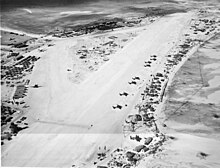
During the early on months of 1942, the main responsibility for anti-submarine warfare in the United States was shouldered by the Army Air Forces. This irked the Navy, as it considered this region of battle its brunt. To comport out such a task, the Navy was pursuing a long-range, land-based patrol and reconnaissance shipping with a substantial flop load. This goal was ever resisted past the Ground forces Air Forces, which carefully protected its monopoly on land-based bombing. This forced the navy to use long-range floatplanes for these roles. The Navy was unable to upgrade to more capable aircraft until the Army Air Forces needed the Navy found in Renton, Washington to manufacture its Boeing B-29 Superfortress. In exchange for use of the Renton plant, the Army Air Forces would discontinue its objections to Naval state-based bombers, and provide aircraft to the Navy. One of the clauses of this agreement stated that production of the B-34 and B-37 by Lockheed would end, and instead these resources would be directed at building a navalized version, the PV-ane Ventura.
The PV-i began to exist delivered in December 1942, and entered service in Feb 1943. The kickoff squadron in gainsay was VP-135, deployed in the Aleutian Islands in Apr 1943. They were operated by three other squadrons in this theatre. From the Aleutians, they flew strikes against Paramushiro, a Japanese island. Frequently, PV-1s would lead B-24 bomber formations, since they were equipped with radar. In late 1943, PV-1s were deployed to the Solomon Islands and to the newly captured field at Tarawa in the Gilbert Islands. Later the war, the U.S. Navy deemed many PV-1s obsolete and the shipping were sent to Naval Air Station Clinton, Oklahoma to exist demilitarized and reduced to scrap.
Other operators [edit]
- Brazil (15 Venturas, 5 Harpoons)
- Italy (22 Harpoons)
- Nihon (17 Harpoons)
- Netherlands (eighteen Harpoons)
- Republic of peru (half dozen Harpoons)
Variants [edit]
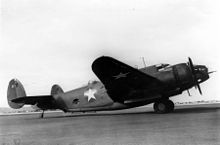
1 of 18 USAAF B-37s, 1943.

A PV-3 in early 1943. It was assigned in Oct 1942 to VP-82 which operated from Naval Air Station Argentia, Newfoundland on anti-submarine patrols over the Atlantic.
- B-34
- US designation for the Model 137 (with 2000hp R-2800-31 engines) bought for the Imperial Air Force, 200 congenital and designated the Ventura IIA by the British.[xix]
- B-34A
- Former Royal Air Force Venturas returned to USAAF under a reverse lend-lease.[19]
- B-34B
- B-34As converted as navigation trainers.[xix]
- B-37
- Lockheed Model 437 for the USAAF (with 1700hp R-2600-13 engines), only eighteen out of an order of 550 built for armed observation. Originally designated the O-56, it was later designated the RB-37.[19]
- PV-one
- United States Navy version of the B-34; one,600 built. A total of 388 were delivered to the Royal Air Force every bit the Ventura GR.5, others to the RAAF, RNZAF and SAAF.[19]
- PV-1P
- Designation for PV-1s fitted with a camera installation.[19]
- PV-two Harpoon
- Updated model with larger fin and fly area; 470 built.[19]
- PV-2C
- Modified version of the PV-2 used for grooming; 30 built.[19]
- PV-2D
- Same equally PV-two but with viii 0.5in nose guns; 35 built.[xix]
- PV-2T
- Designation for PV-2s used for crew training.[19]
- PV-3
- 20-seven onetime RAF Ventura IIs requisitioned by the USN.[19]
- Ventura I
- R-2800-S1A4-G powered variant for the Purple Air Force; 188 built, 30 to the RCAF and some to the SAAF, later re-designated the Ventura GR.I.[19]
- Ventura 2
- R-2800-31 powered variant for the RAF, 487 built, some transferred to the USAAC and USN.[19]
- Ventura IIA
- British designation for the B-34.[19]
- Ventura Five
- British designation for the PV-1, later designated Ventura GR.V.[19]
Operators [edit]

Retired PV-one at the SAAF Museum

-
 Australia
- Royal Australian Air Force 75 aircraft, 1943–1946
-
- No. 13 Squadron RAAF
- No. 459 Squadron RAAF
- No. 464 Squadron RAAF
-
 Brazil
- Brazilian Air Force 20 shipping 1944–1956
- 1st Medium Bomber Grouping
-
 Canada
- Purple Canadian Air Force (RCAF) 286 aircraft 1943–1957
- Operational Squadrons of the Home War Establishment (HWE):
-
- No. viii Squadron RCAF
- No. 113 Squadron RCAF
- No. 115 Squadron RCAF
- No. 145 Squadron RCAF
- No. 149 Squadron RCAF
-
 French republic
- French Navy – Aeronavale 1944–1961
- Flottille 6F (PV-1 just, from 1944 to 1947)
- Escadrille 11S (PV-ane from 1947 to 1953 and six PV-2s from 1953 to 1960) for transport duty only.
-
 Italian republic
- Italian Air Force operated 22 Lockheed PV-ii Harpoon from 1953 until 1959[20]
-
 Nippon
- Japan Maritime Cocky-Defence Forcefulness 17 shipping from 1955 to 1960
- Kanoya Flying Training Wing
-
 Netherlands
- Dutch Naval Aviation Service 18 aircraft from 1951 to 1955
- No. 320 (Netherlands) Squadron RAF
-
 New Zealand
- Royal New Zealand Air Force 143 aircraft from 1943 to 1948
-
- No. ane Squadron RNZAF
- No. two Squadron RNZAF
- No. 3 Squadron RNZAF
- No. four Squadron RNZAF
- No. 8 Squadron RNZAF
- No. nine Squadron RNZAF
- No. 487 Squadron RNZAF
- No. 1 (B) OTU
- No. 14 Servicing Unit
-
 Portugal
- Portuguese Air Strength 42 aircraft from 1954 to 1975
- Squadron 61, Montijo Air Base (1954–1960)
- Squadron 62, Montijo Air Base (1954–1960)
- Squadron 91, Luanda Air Base, Angola (1961–1971)
- Squadron 103, Beira Air Base, Mozambique (1962)
- Squadron 101, Beira Air Base, Mozambique (1962–1975)
- Squadron 401, Henrique de Carvalho Air Base, Angola (1971–1975)
-
 Due south Africa to 1960
- South African Air Forcefulness
-
- 17 Squadron SAAF
- 22 Squadron SAAF
- 23 Squadron SAAF
- 25 Squadron SAAF
- 27 Squadron SAAF
- 29 Squadron SAAF
- lx Squadron SAAF
-
 Great britain
- Royal Air Forcefulness
-
- No. 13 Squadron RAF (Coastal Command)
- No. 21 Squadron RAF
- No. 299 Squadron RAF
- No. 500 Squadron RAF
- No. 519 Squadron RAF (Coastal Command)
- No. 521 Squadron RAF (Coastal Command)
- No. 624 Squadron RAF
- No. 34 OTU, RAF, operated from Pennfield Ridge, New Brunswick
- Air Headquarters Iraq Communication Flight[21]
- Majestic Navy 1 shipping for evaluation only
-
 Usa
Usa

A USMC PV-1 dark fighter from VMF(N)-531 in the Solomons, 1943.

- United States Marine Corps
- VMF(N)-531
- United States Navy
-
- VB/VPB-125 — (PV-1) September 1942 – June 1945[22]
- VB/VPB-126 — (PV-1) March 1943 – June 1945[23]
- VB/VPB-127 — (PV-one) March 1943 – July 1945[24]
- VB/VPB-128, VP-ML-1 — (PV-one) February 1943 – Nov 1946, (PV-2) November 1946 – September 1947[25]
- VB/VPB-129 — (PV-1) April 1943 – June 1945[26]
- VB/VPB-130, VP-ML-2 — (PV-one) March 1943 – May 1945, (PV-2) August 1945 – March 1947[27]
- VB/VPB-131 — (PV-1) March 1943 – August 1945, (PV-2) September 1945 – April 1946.[28]
- VB/VPB-132 — (PV-1) March 1943 – May 1945[29]
- VB/VPB-133 — (PV-i) March 1943 – 1946, (PV-two) 1946[thirty]
- VPB-134VB/VPB-134 — (PV-ane) April 1943 – Apr 1945[31]
- VB/VPB-135, VP-ML-5 — (PV-1) Feb 1943 – June 1945, (PV-2) June 1945 – June 1948[32]
- VB/VPB-136 — (PV-i) June 1943 – March 1945, (PV-2) May 1945 – 1946[33]
- VB/VPB-137 — (PV-1) March 1943 – July 1945[34]
- VB/VPB-138 — (PV-1) March 1943 – November 1944[35]
- VB/VPB-139 — (PV-1) May 1943 – June 1944, (PV-2) August 1944 – September 1945[36]
- VB/VPB-140 — (PV-i) April 1943 – May 1944[37]
- VB/VPB-141 — (PV-1) July 1943 – April 1945, (PV-ii) April 1945 – June 1945[38]
- VB/VPB-142 — (PV-1) June 1943 – January 1945, (PV-2) January 1945 – May 1946[39]
- VB/VPB-143 — (PV-1) June 1943 – 1945[40]
- VB/VPB-144 — (PV-one) July 1943 – September 1944, (PV-2) November 1944 – May 1946[41]
- VB/VPB-145 — (PV-one) July 1943 – June 1945[42]
- VB/VPB/VP-146, VP-ML-6 — (PV-1) July 1943 – February 1945, (PV-ii) Apr 1945 – February 1948[43]
- VB/VPB-147 — (PV-i) August 1943 –May 1945, (PV-2) Apr 1945 – July 1945[44]
- VB/VPB-148 — (PV-i) October 1943 – Apr 1945, (PV-2) June 1945 – June 1946[45]
- VB/VPB-149 — (PV-1) September 1943 – September 1945[46]
- VB/VPB-150 — (PV-one) November 1943 – March 1945, (PV-2) May 1945 – July 1945[47]
- VB/VPB-151 — (PV-1) Jan 1944 – June 1945[48]
- VB/VPB-152 — (PV-ane) April 1944 – June 1946[49]
- VB/VPB-153 — (PV-ane) April 1944 – October 1945, (PV-2) November 1945 – June 1946[50]
- VB/VPB-200
- VD-2
Survivors [edit]
Commonwealth of australia [edit]
- Under restoration
- PV-1 ?? – former RAAF aircraft A59-73, endemic by the East Arnhemland Historical Gild and nether restoration in Darwin for eventual display at Gove, Northern Territory.[51]
- PV-1 49555 – nether restoration by the Queensland Air Museum in Caloundra, Queensland, painted with its Royal Australian Air Force serial of A59-96.[52]
- Stored
- PV-1 33369 - stored by the Royal Australian Air Strength Museum awaiting restoration to static brandish standard; previously operated by the RAAF Celebrated Flight, 1988–96, as VH-SFF (quondam N159U), painted as A59-67.[53]
Brazil [edit]
- On brandish
- PV-ane 48654, c/north 237–58906, sometime N165H – Museu Aeroespacial in Rio de Janeiro.[54]
Canada [edit]
- Nether restoration
- PV-1 33315 – under restoration by the Ventura Memorial Flying Association in Edmonton, Alberta.[55]
New Zealand [edit]
- On brandish
- RB-34 41-38117 (NZ4600) – Museum of Transport and Technology in Auckland.[56]
Southward Africa [edit]
- On display
- PV-ane 34759 – Dickie Fritz Shell Hole M.O.T.H. chemical compound in Johannesburg.[57]
United States [edit]
- Airworthy
- PV-one 34670 – privately owned in Eagan, Minnesota.[58]
- PV-2 37107 – privately owned in Orangish, California.[59]
- PV-2 37129 - Wingspan Air Heritage Foundation in Mesa, Arizona.[60]
- PV-2 37211 – Palm Springs Air Museum in Palm Springs, California.[61] [62]
- PV-2 37270 – Wingspan Air Heritage Foundation in Mesa, Arizona.[63]
- PV-2 37276 - privately owned in Eugene, Oregon.[64]
- PV-2 37254 – privately owned in Fairacres, New Mexico.[65]
- PV-2 37396 – American Military Heritage Foundation in Indianapolis, Indiana.[66] [67]
- PV-2 37466 – privately owned in Orangish, California.[68]
- PV-2 37507 - privately endemic in Mesa, Arizona.[69]
- PV-2 37535 – Erickson Aircraft Collection in Madras, Oregon.[70] [71]
- PV-ii 37633 – Wingspan Air Heritage Foundation in Mesa, Arizona.[72]
- PV-2 84062 – Stockton Field Aviation Museum in Stockton, California.[73] [74]
- On display
- PV-2 37230 – National Museum of Naval Aviation in Pensacola, Florida.[75]
- PV-two 37257 – Pima Air Museum in Tucson, Arizona.[76]
- PV-2 37492 – painted (yellow) and marked "Air Tropic Isle Charters" at Mayday Golf in Due north Myrtle Beach, South Carolina.[77]
- Under restoration or in storage
- B-34 41-38032 – for static display past Naval Air Station Sanford Memorial Committee at the Orlando Sanford International Airport'southward Naval Air Station Sanford Memorial Park, Sanford, Florida.
Aircraft is on loan from the National Naval Aviation Museum.[78] - PV-2 37202 – in storage at the Fantasy of Flight in Polk Metropolis, Florida.[79]
- PV-2 84060 – in storage at the Cavanaugh Flying Museum in Addison, Texas.[80] [81]
- RB-34 AJ311 – in storage at the National Museum of the Us Air Forcefulness in Dayton, Ohio.[82]
Specifications (B-34 Lexington) [edit]

PV-i Ventura iii-side-drawing

PV-2 Harpoon 3-side-drawing
Information from [ citation needed ]
General characteristics
- Coiffure: 6
- Length: 51 ft 5 in (15.7 thousand)
- Wingspan: 65 ft 6 in (20 yard)
- Height: 11 ft 10 in (3.six m)
- Wing area: 551 sq ft (51.2 m2)
- Empty weight: 20,197 lb (ix,161 kg)
- Gross weight: 31,000 lb (xiv,061 kg)
- Max takeoff weight: 34,000 lb (15,422 kg)
- Powerplant: 2 × Pratt & Whitney R-2800 radial engines, two,000 hp (ane,500 kW) each
Performance
- Maximum speed: 322 mph (518 km/h, 280 kn)
- Cruise speed: 230 mph (370 km/h, 200 kn)
- Range: 1,660 mi (two,670 km, 1,440 nmi)
- Ferry range: 2,600 mi (4,200 km, ii,300 nmi)
- Service ceiling: 26,300 ft (8,020 m)
- Rate of climb: 2,035 ft/min (xv.4 m/s)
- Wing loading: 56.4 lb/sq ft (275 kg/m2)
- Power/mass: 0.thirteen hp/lb (0.21 kW/kg)
Armament
- Guns:
- 4 × .50 BMG (12.seven mm) Browning M2 machine guns
- 2 × .thirty cal. (7.62 mm) M1919 Browning auto guns
- Bombs:
- 3,000 lb (1,400 kg) general ordnance or
- 6 × 325 lb (147 kg) depth charges or
- 1 × torpedo
Come across also [edit]
- Lockheed PV-2 Harpoon No. 37396
Aircraft of comparable role, configuration, and era
- Junkers Ju 88
- Kyushu Q1W Tōkai
Related lists
- List of armed forces aircraft of the United States
- List of United states of america Navy aircraft designations (pre-1962)
- Listing of bomber aircraft
- List of Lockheed shipping
- List of aircraft of World War Ii
References [edit]
Notes [edit]
- ^ Marson, 2001, p. 27
- ^ Taylor 1965, p.244.
- ^ Marson, 2001, p. 26
- ^ "Fred Miller, son die in fiery plane crash". Milwaukee Sentinel. December xviii, 1954. p. one.
- ^ "Fred C. Miller, son killed in air crash". Milwaukee Journal. December 18, 1954. p. one.
- ^ "Pilots buried adjacent". Milwaukee Journal. December 20, 1954. p. 2.
- ^ "CAB findings in Miller crash". Milwaukee Lookout man. March 18, 1955. p. ane, function 2.
- ^ "Briefings . . ". Flight. New York, New York: Ziff-Davis. August 1958. p. 90. Retrieved January x, 2020.
- ^ "Personal & Business Fixed-Wing Aircraft". Flight. New York, New York: Ziff-Davis. October 1960. p. 22. Retrieved October 8, 2014.
- ^ CARDOSO, Adelino, Aeronaves Militares Portuguesas no Século XX, Lisbon: Essencial, 2000
- ^ Francillon 1982, p. 198.
- ^ Bowyer 1974, p. 254.
- ^ Bowyer 1974, pp. 254–256.
- ^ Bowyer 1974, p. 261.
- ^ Carey 2002, p. 12.
- ^ Bowyer 1974, pp. 263, 266, 273.
- ^ Bowyer 1974, pp. 280, 282.
- ^ Andrade 1979, p. 247
- ^ a b c d due east f g h i j k l m n o Andrade 1979, pp. 52–53, 207–208, 247.
- ^ "Italian Air Force Aircraft Types". www.aeroflight.co.united kingdom.
- ^ Lake, Alan 1999 p.xviii.
- ^ Roberts 2000, Chapter iv, pp. 548–549.
- ^ Roberts 2000, Chapter 4, p. 553.
- ^ Roberts 2000, Chapter four, pp. 555–556.
- ^ Roberts 2000, Chapter three, pp. 18–19, 23.
- ^ Roberts 2000, Affiliate 4, pp. 557–559.
- ^ Roberts 2000, Chapter 3, pp. 26–27.
- ^ Roberts 2000, Chapter 3, pp. 373–375.
- ^ Roberts 2000, Affiliate four, pp. 561–562.
- ^ Roberts 2000, Chapter 3, pp. 377–379.
- ^ Roberts 2000, Chapter 4, pp. 563–564.
- ^ Roberts 2000, Chapter three, pp. 42, 45–46.
- ^ Roberts 2000, Chapter 3, pp. 29–33.
- ^ Roberts 2000, Affiliate 4, pp. 565–566.
- ^ Roberts 2000, pp. 625, 627.
- ^ Roberts 2000, Affiliate 4, pp. 567–568.
- ^ Roberts 2000, Affiliate 3, pp. 370–371.
- ^ Roberts 2000, Affiliate iv, pp. 570–561.
- ^ Roberts 2000, Chapter 4, pp. 382–383.
- ^ Roberts 2000, pp. 629–630.
- ^ Roberts 2000, Affiliate iii, pp. 34–35.
- ^ Roberts 2000, Chapter 4, pp. 572–573.
- ^ Roberts 2000, Chapter 3, pp. 53–54, 57.
- ^ Roberts 2000, Affiliate four, pp. 574–575.
- ^ Roberts 2000, Chapter 3, pp. 383–384.
- ^ Roberts 2000, Affiliate 4, pp. 576–577.
- ^ Roberts 2000, Chapter 4, pp. 578–580.
- ^ Roberts 2000, Chapter 4, pp. 581–582.
- ^ Roberts 2000, Chapter 3, pp. 385–386.
- ^ Roberts 2000, Affiliate three, pp. 387–388.
- ^ "ADF Serials - Ventura".
- ^ "PV-1 Ventura/49555." Archived 2012-03-18 at the Wayback Machine Queensland Air Museum. Retrieved: 2 April 2012.
- ^ https://www.airforce.gov.au/sites/g/files/net3736/f/minisite/static/1469/RAAFmuseum/exhibitions/b_scenes/air_store/ventura.htm [ dead link ]
- ^ "Lockheed PV-1/Bu. 48654" Musea Aeroespacial – in Spanish Retrieved: 29 August 2014.
- ^ "PV-i Ventura/33315." Warbird Registry. Retrieved: i June 2011.
- ^ "RB-34 Ventura/41-38117." Warbirds Resource Group. Retrieved: 20 April 2011.
- ^ "PV-1 Ventura/34759." Warbirds Resource Group. Retrieved: 20 Apr 2011.
- ^ "FAA Registry: N500LN." FAA.gov Retrieved: xix July 2021.
- ^ "FAA Registry: N7261C." FAA.gov Retrieved: 19 July 2021.
- ^ "FAA Registry: N7268C." FAA.gov Retrieved: 19 July 2021.
- ^ "FAA Registry: N7273C." FAA.gov Retrieved: xix July 2021.
- ^ "PV-ii Harpoon/Bu. 37211." Palm Springs Air Museum. Retrieved: 19 July 2021.
- ^ "FAA Registry: N7257C" FAA.gov Retrieved: 19 July 2021.
- ^ "FAA Registry: N7272C." FAA.gov Retrieved: 19 July 2021.
- ^ "FAA Registry: N2PV." FAA.gov Retrieved: nineteen July 2021.
- ^ "FAA Registry: N7256C." FAA.gov Retrieved: 19 July 2021.
- ^ "PV-2 Harpoon/Bu. 37396." American Armed services Heritage Foundation. Retrieved: 19 July 2021.
- ^ "FAA Registry: N6855C." FAA.gov Retrieved: 19 July 2021.
- ^ "FAA Registry: N86492." FAA.gov Retrieved: 19 July 2021.
- ^ "FAA Registry: N83L." FAA.gov Retrieved: nineteen July 2021.
- ^ "PV-2 Harpoon/Bu. 37535." Erickson Aircraft Collection. Retrieved: 21 August 2014.
- ^ "FAA Registry: N7454C." FAA.gov Retrieved: 19 July 2021.
- ^ "FAA Registry: N6657D." FAA.gov Retrieved: 19 July 2021.
- ^ "PV-2 Harpoon/Bu. 84062." Stockton Field Aviation Museum. Retrieved: 23 February 2014.
- ^ "PV-2 Harpoon/Bu. 37230." National Museum of Naval Aviation. Retrieved: ten April 2012.
- ^ "PV-two Harpoon/Bu. 37257." Pima Air Museum. Retrieved: 19 July 2021.
- ^ "PV-2 Harpoon/Bu. 37492." Mayday Golf. Retrieved: 21 August 2012.
- ^ "B-34 Ventura/41-38032." NAS Sanford Memorial. Retrieved: 20 April 2011.
- ^ "FAA Registry: N7483C." FAA.gov Retrieved: 19 July 2021.
- ^ "FAA Registry: N86493." FAA.gov Retrieved: 19 July 2021.
- ^ "PV-two Harpoon/Bu. 84060." Cavanaugh Flight Museum. Retrieved: xix July 2021.
- ^ "Airframe Dossier - Lockheed RB-34 Lexington, s/n AJ311 FABr, c/n 237-4449". Aerial Visuals . Retrieved 16 Jan 2022.
Bibliography [edit]
- Andrade, John. U.S. Military Aircraft Designations and Serials since 1909. Hersham, Surrey, UK: Midland Counties Publications, 1979. ISBN 0-904597-22-9.
- Bowyer, Michael J. F. 2 Group R.A.F.: A Complete History, 1936–1945.London: Faber and Faber, 1974. ISBN 0-571-09491-0.
- Carey, Alan C. PV Ventura / Harpoon Units of Earth War 2 (Osprey Combat Shipping 34). Botley, U.k.: Osprey Publishing, 2002. ISBN ane-84176-383-7.
- Francillon, René J. Lockheed Aircraft since 1913. London: Putnam, 1982. ISBN 0-370-30329-half-dozen.
- Marson, Peter J., The Lockheed Twins. Air-Britain (Historians) Ltd, Tonbridge, Kent, 2001. ISBN 0-85130-284-X.
- Roberts, Michael D., Captain, MSC, USNR (Ret.).Dictionary of American Naval Aviation Squadrons, Book 2: The History of VP, VPB, VP(H) and VP(AM) Squadrons. Washington, D.C.: Naval Aviation History Part, 2000.
- Scrivner, Charles L. and Westward.E. Scarborough, Captain USN (ret). Lockheed PV-1 Ventura in Activeness. Carrollton, Texas: Squadron/Signal Publications, Inc., 1981. ISBN 0-89747-118-0.
- Stanaway, John C. Vega Ventura: The Operational Story of Lockheed'due south Lucky Star. Atglen, Pennsylvania: Schiffer Publishing, 2000. ISBN 0-7643-0087-three.
- Taylor, John W. R. Jane'southward All The Globe's Aircraft 1965–66. London: Sampson Low, Marston, 1965.
- Lake, Alan. FLYING UNITS OF THE RAF – The ancestry, formation and disbandment of all flying units from 1912. England: Alan Lake, 1999, ISBN 1-84037-086-half-dozen.
External links [edit]
- The shipping in Lake Washington.
- USAF Museum B-34 fact sheet
- USAF Museum B-37 fact sheet
- "The Versatile Ventura" June 1945 Pop Scientific discipline—note: rare photos of loading of various weapon loads
- "2000 Mile Navy Bomber" Popular Mechanics, Nov 1945, p. ten.
- Ralls Clotfelter, 2003, "PV-ane Ventura in the Pacific – Lockheed'due south forgotten warbird" (archive.org copy of the original as of 3 Apr 2007 )
- Encyclopedia of American Aircraft
- US Navy Patrol Squadrons
- PBS Nova program nigh "Bomber 31"
- Web site most RNZAF apply
- Ventura Memorial Flight Association (VMFA)
- Alberta Aviation Museum
- American Military machine Heritage Foundation (AMHF)
- Lockheed Twins Site – civil Ventura conversions
- 1946 transmission AN 01-55ED-i Pilots Handbook for Navy Model PV-2 PV-2C PV-second Airplanes [ permanent dead link ]
- Registry Of Lockheed PV-one Ventura survivors
Source: https://en.wikipedia.org/wiki/B-34_Ventura
0 Response to "Ventura Kc When Will I See U Again"
Postar um comentário